














When comparing hotel booking plugins vs OTAs, hotels must decide whether to gain visibility through Online Travel Agencies (OTAs) or maximize profits through direct bookings.
OTAs like Booking platforms charge commissions ranging from 15% to 30%, while hotel booking plugins allow hotels to accept direct reservations without paying recurring commissions.
For most hotels, using hotel booking plugins alongside limited OTA exposure provides the best balance between visibility and profitability.
What is a Hotel Booking Plugin?
A hotel booking plugin is a specialized software extension—most commonly built for platforms like WordPress—that embeds a complete reservation and property management system directly into a website. It functions as the digital infrastructure that enables a hospitality business to publish inventory (rooms), manage availability in real time, calculate dynamic pricing, process bookings, and handle guest data within a single, integrated environment.
From a technical perspective, a hotel booking plugin acts as a middleware layer between the website’s user interface and the backend booking logic. It structures data such as room types, rates, occupancy rules, and booking constraints, then uses this data to power a transactional workflow where users can search availability, select dates, and complete reservations. At the same time, it synchronizes booking data with calendars, applies pricing rules (including seasonal or demand-based variations), and enforces business logic like minimum stay requirements or cancellation policies.
Unlike generic form plugins, a hotel booking plugin is purpose-built for the hospitality domain. It incorporates real-time inventory control, date-based logic, payment processing integrations, and automated communication systems, making it closer to a lightweight Property Management System (PMS). This allows hotel owners or property managers to operate direct bookings from their own website while maintaining control over pricing, customer relationships, and operational workflows, without fully relying on external booking platforms.
What is an OTA (Online Travel Agency)?
An OTA (Online Travel Agency) is a digital platform that acts as an intermediary marketplace between travelers and travel service providers, enabling users to search, compare, and book services such as hotels, flights, vacation rentals, and car rentals in one place.
In a deeper sense, an OTA is not just a booking website; it is a distribution and aggregation system. It collects inventory such as room availability, pricing, and flight schedules from multiple suppliers, including hotels, airlines, and tour operators, and presents that data through a unified interface. This allows travelers to evaluate options based on price, location, amenities, and reviews, and complete transactions instantly.
Well-known examples include Booking.com, Expedia, and Airbnb.
From a technical and business perspective, OTAs function as two-sided platforms. On the one hand, they provide travelers with search tools, filtering systems, price comparisons, and secure booking workflows. On the other hand, they offer suppliers, such as hotels, a powerful distribution channel, giving them access to a global audience they might not reach through their own websites.
OTAs typically monetize through commission-based models, charging service providers a percentage of each booking. Some platforms may also include listing fees, advertising placements, or service charges to customers.
In essence, an OTA centralizes fragmented travel supply into a single ecosystem, simplifying the booking process for users while acting as a strong visibility and revenue channel for travel businesses.
Hotel Booking Plugin vs OTA: Quick Comparison Chart
| Aspect | Hotel Booking Plugin | OTA (Online Travel Agency) |
|---|---|---|
| Platform Type | Installed on your own site (e.g., WordPress) | Third-party marketplace |
| Examples | Your own website system | Booking.com, Expedia, Airbnb |
| Ownership | Full control over system and data | Limited control, platform owns ecosystem |
| Commission Fees | No commission per booking | 10%–30% per booking |
| Traffic Source | You generate your own traffic | Built-in global audience |
| Branding | Fully customizable branding | Limited customization |
| Customer Data | Full access to guest data | Restricted access |
| Profit Margin | Higher (no middleman cuts) | Lower due to commissions |
| Setup Effort | Requires setup and marketing | Easy to start instantly |
| Long-Term Value | Builds your own asset | Builds OTA’s platform |
Hotel Booking Plugin vs OTA: Key Differences
Understanding the difference between a hotel booking plugin and an OTA (Online Travel Agency) is crucial if you want to control bookings, maximize revenue, and scale your hospitality business strategically.
1. Ownership and control
A hotel booking plugin, typically built for platforms like WordPress, gives you full ownership of your booking system. You control pricing, customer data, branding, and the entire user experience directly on your website.
In contrast, an OTA like Booking.com or Expedia operates as a third-party marketplace. While it brings visibility, it also means you do not fully own the customer relationship, and your listings exist within their platform rules and ecosystem.
2. Cost structure and profit margins
With a hotel booking plugin, your primary costs are setup, maintenance, and payment gateway fees through providers like Stripe or PayPal. There is no commission per booking, which helps you retain higher profit margins over time.
On the other hand, OTAs typically charge commission fees ranging from 10 percent to 30 percent per booking. While this cost is justified by their reach, it significantly impacts long-term profitability.
3. Traffic and customer acquisition
A hotel booking plugin relies on your own marketing efforts, such as SEO, paid ads, or social media to drive traffic. You build your audience from scratch, but you also build a long-term asset.
OTAs already have massive built-in traffic. Platforms like Airbnb attract millions of users, making it easier to get bookings quickly without heavy marketing investment.
4. Branding and user experience
Using a booking plugin allows you to create a fully branded experience. From design to messaging, everything reflects your business identity, helping build trust and repeat customers.
With OTAs, your listing is standardized. You compete side by side with other properties, and branding opportunities are limited to photos, descriptions, and reviews.
5. Data ownership and customer relationship
A hotel booking plugin gives you direct access to customer data, enabling personalized marketing, email campaigns, and loyalty programs.
OTAs act as intermediaries, often restricting access to customer information. This limits your ability to build long-term relationships and remarket effectively.
6. Scalability and business strategy
A plugin-based system is ideal for building a direct booking strategy over time. It becomes more valuable as your brand grows and repeat customers increase.
OTAs are excellent for initial exposure and occupancy growth, especially for new hotels or during low seasons. However, over-reliance can make your business dependent on external platforms.
Why Hotels Should Focus on Direct Bookings
Focusing on direct bookings is no longer just an option for hotels it is a strategic necessity if you want to maximize profitability, build a strong brand, and create long-term customer relationships.
Higher profit margins
Every booking that comes through an OTA like Booking.com or Expedia typically includes a commission fee that can significantly cut into your revenue. Direct bookings eliminate these middleman costs, allowing you to retain more profit per reservation and reinvest it into your business.
Full control over customer experience
When guests book directly through your website, you control every touchpoint from the first interaction to post-stay communication. Using your own system, often powered by platforms like WordPress, you can design a seamless and branded booking journey that reflects your hotel’s identity rather than being confined to a standardized OTA interface.
Access to valuable customer data
Direct bookings give you full access to guest information, including email addresses, preferences, and booking behavior. This data is essential for personalized marketing, loyalty programs, and repeat bookings. OTAs, on the other hand, limit how much of this data you can use, restricting your ability to build lasting relationships.
Stronger brand loyalty
When customers book through OTAs, their loyalty is often tied to the platform, not your hotel. Direct bookings shift that loyalty back to your brand. By offering exclusive perks, better rates, or personalized experiences, you encourage guests to return directly instead of going through platforms like Airbnb.
Better pricing flexibility
Direct booking channels allow you to experiment with pricing strategies such as discounts, packages, or seasonal offers without being constrained by OTA rules or rate parity agreements. This flexibility helps you stay competitive while optimizing revenue.
Reduced dependency on third parties
Relying too heavily on OTAs can make your business vulnerable to algorithm changes, ranking factors, or policy updates that are outside your control. Building a strong direct booking channel gives you independence and stability over time.
Long-term business growth
Direct bookings are not just about saving commission fees; they are about building a sustainable business. Over time, your website becomes a powerful asset that consistently generates bookings, strengthens your brand, and improves customer retention.
When Should Hotels Use OTAs?
OTAs such as Booking.com, Expedia, and Airbnb are powerful distribution channels, but they are not meant to replace direct bookings. Instead, they are most effective in specific situations where reach, speed, and visibility matter more than margin control.
i. When you are a new or unknown hotel
If your property is newly launched or lacks brand recognition, OTAs are one of the fastest ways to gain visibility. These platforms already have massive global traffic, which helps you get discovered without needing a strong SEO or marketing foundation. In this stage, OTAs act as a demand generator that helps you fill rooms quickly and build initial reviews.
ii. When you need immediate occupancy
Hotels often experience seasonal fluctuations, low demand periods, or unexpected cancellations. In these situations, OTAs become a valuable tool for last-minute bookings. Because millions of users actively search for accommodation on these platforms, they can help you maintain occupancy rates when direct bookings are slow.
iii. When expanding into new markets
If you are entering a new city, country, or travel segment, OTAs help you test demand without heavy upfront investment. Instead of building full marketing infrastructure immediately, you can list your property on platforms like Booking.com or Expedia to understand traveler behavior and pricing expectations in that market.
iv. When you need global reach without marketing costs
Building global visibility through direct channels requires strong SEO, advertising, and brand trust. OTAs already solve this problem by aggregating millions of travelers in one place. For small and mid-sized hotels, this makes OTAs a cost-effective way to access international customers without large marketing budgets.
v. When building initial reviews and trust
For new properties, reviews are critical for conversion. OTAs provide a structured review system that helps you quickly build credibility. Positive ratings on platforms like Airbnb or Booking.com can significantly influence future guests, both on OTAs and your direct booking website.
vi. When used as a supplement, not a dependency
The most effective strategy is not choosing between OTAs and direct bookings, but balancing both. OTAs should be used as a customer acquisition channel, while your own booking system builds long-term profitability and loyalty.
Hotel Booking Plugin vs OTA: Cost Comparison (Chart)
| Cost Factor | Hotel Booking Plugin (Direct Website) | OTA (Online Travel Agency) |
|---|---|---|
| Setup Cost | One-time or monthly setup for website + booking system | No setup cost to join |
| Platform Cost | Low to moderate (hosting, plugin, maintenance) | None upfront |
| Commission per Booking | 0% commission | 15%–30% per booking |
| Payment Gateway Fees | 1.5%–3.5% (Stripe/PayPal processing) | Often included in OTA commission |
| Marketing Cost | SEO, ads, content (variable 5%–12% of booking value) | Built into OTA commission (no separate marketing spend) |
| Monthly Fixed Cost | Low fixed cost (plugin, hosting, tools) | No fixed cost, pay only per booking |
| Revenue Retention | 85%–95%+ kept by hotel (after small fees) | 70%–85% after commission |
| Profit Margin | Higher long-term margin | Lower due to recurring commission cuts |
| Scalability Cost | Improves as bookings increase (fixed costs stay similar) | Increases directly with every booking |
| Hidden Costs | Website maintenance, SEO effort | Visibility upgrades, discount programs, parity pressure |
Who Should Use the Hotel Booking Plugin?
A hotel booking plugin is best suited for any hospitality business that wants to take control of direct reservations, reduce dependency on OTAs, and build long-term profitability through its own website.
Independent hotels and boutique properties
Small and independent hotels benefit the most because they often rely heavily on OTAs like Booking.com for visibility. A booking plugin allows them to start building their own direct booking channel while still competing with larger hotel chains.
Vacation rentals and short-term rentals
Property owners managing villas, apartments, or holiday homes can use a booking plugin to handle availability, pricing, and guest reservations without relying fully on platforms like Airbnb. It gives them more control over bookings and reduces platform dependency.
Hotel chains and multi-property businesses
Larger hotel groups use booking plugins to centralize reservation management across multiple locations. This helps them maintain consistent pricing strategies, manage inventory efficiently, and reduce OTA commission costs at scale.
Travel agencies and hospitality startups
New travel businesses that want to build a branded booking website from scratch can use a hotel booking plugin to quickly launch a functional reservation system without developing complex software. This is especially useful when using platforms like WordPress.
Resorts, hostels, and guesthouses
Any accommodation business that needs to manage room availability, seasonal pricing, and guest communication can benefit. It simplifies operations while improving the customer booking experience directly on their own website.
Businesses focused on a direct bookings strategy
If your goal is to reduce commission dependency and increase profit margins, a booking plugin is essential. It supports a long-term strategy where direct bookings gradually replace OTA-driven revenue.
SEO Benefits of Hotel Booking Plugin
A hotel booking plugin does more than manage reservations it also plays a major role in improving a website’s search engine visibility, traffic quality, and long-term ranking potential, especially when built on platforms like WordPress.
1. Better control over on-page SEO
With a hotel booking plugin, you can fully optimize your own pages, including room listings, pricing pages, and location pages. This allows you to target high-intent keywords like “hotel in [city]” or “book luxury suite,” which helps search engines understand your content more clearly and rank it higher in organic results.
2. Increased content indexation opportunities
Each room type, property, or location page created through the plugin becomes a separate indexable page. This expands your website’s content footprint and improves your chances of ranking for multiple long tail search queries instead of relying on a single homepage.
3. Stronger internal linking structure
Booking plugins naturally create structured navigation between rooms, availability calendars, and booking pages. This improves internal linking, helping search engines crawl your website more efficiently and distribute ranking authority across important pages.
4. Higher engagement signals
A smooth booking experience reduces bounce rates and increases time on site. When users interact with availability calendars, room filters, and booking forms, search engines interpret this as positive engagement, which can indirectly improve rankings.
5. Direct Traffic Instead of Referral Dependency
Unlike relying on OTAs like Booking.com or Expedia, a booking plugin helps you build organic traffic directly to your own domain. This means every SEO effort contributes to your own website growth rather than a third-party platform.
6. Schema markup and structured data support
Many hotel booking plugins support structured data such as availability, pricing, and reviews. This helps search engines better understand your listings and can improve visibility in rich results like snippets and local search listings.
7. Faster content updates for SEO optimization
You can quickly update pricing, availability, and promotional content without technical delays. This allows you to react to seasonal trends, keyword opportunities, and competitor changes faster, keeping your SEO strategy dynamic.
8. Long-term domain authority growth
As more bookings, backlinks, and content accumulate on your website, your domain authority increases over time. This makes it easier to rank for competitive keywords compared to relying on OTAs, where authority is owned by the platform, not your brand.
Easy Hotel Booking Plugin: Smarter Way to Build Direct Reservations
If you are looking for a simple yet powerful way to manage hotel reservations on your website, the Easy Hotel Booking is designed exactly for that purpose. It helps you turn any WordPress-based website into a fully functional booking system without complex development or expensive third-party tools.
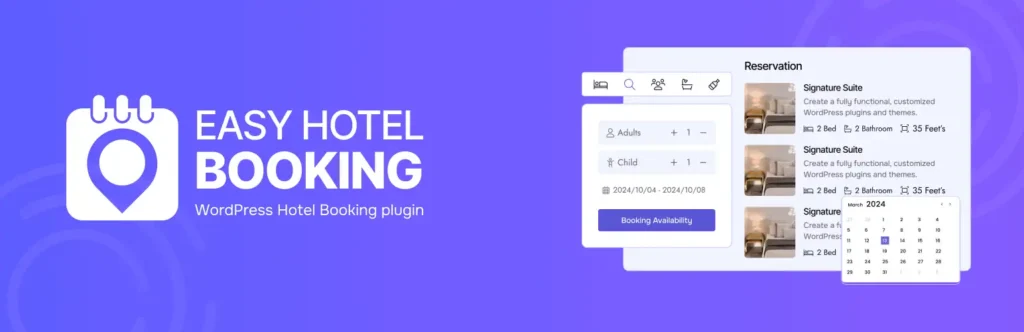
Built for flexibility and ease of use, it allows hotel owners, property managers, and travel businesses to accept direct bookings, manage availability, and automate reservations from one centralized dashboard.
Why Easy Hotel Booking stands out
The Easy Hotel Booking plugin focuses on one core idea: making direct bookings simple and profitable. Instead of relying heavily on OTAs like Booking.com or Expedia, it helps you build your own booking channel where you control everything from pricing to customer experience.
It integrates smoothly with your website, allowing you to create room listings, set seasonal pricing, manage calendars, and accept online payments without technical complexity.
Key benefits for your hotel business
With the Easy Hotel Booking plugin, you can reduce dependency on commission-heavy platforms and start building a stronger direct booking strategy. Every reservation made through your website means higher profit retention and full ownership of customer data.
It also improves user experience by giving guests a clean, fast, and intuitive booking flow, which helps increase conversion rates and reduce drop-offs during the booking process.
Designed for growth and simplicity
Whether you are running a small boutique hotel, a guesthouse, or a growing hospitality brand, the plugin is designed to scale with your business. You can start small and expand your booking system as your property portfolio grows, without switching platforms.
It works especially well for businesses using WordPress, making it easy to integrate with your existing design, pages, and marketing tools.

Final Verdict: Hotel Booking Plugin vs OTA
A hotel booking plugin and an OTA serve two very different but complementary roles in the hospitality ecosystem. The real decision is not about choosing one over the other, but understanding where each creates the most value in your business strategy.
A hotel booking plugin, especially when built on a platform like WordPress, is a long-term growth asset. It gives you full control over branding, pricing, customer data, and direct revenue. Every booking you receive through your own website strengthens your independence, improves profit margins, and builds a sustainable direct booking engine that compounds over time.
In contrast, OTAs such as Booking.com, Expedia, and Airbnb are short-term demand and visibility engines. They provide immediate access to global traffic, help fill rooms during low occupancy periods, and are especially powerful for new or lesser-known properties that need exposure quickly.
From a financial perspective, OTAs reduce profit margins due to commission fees, while booking plugins maximize long-term revenue retention. From a strategic perspective, OTAs accelerate discovery, while booking plugins build ownership and brand equity.
Frequently Asked Questions (FAQs)
Why do hotels prefer direct bookings?
Direct bookings eliminate commission fees and increase profit margins.
Can hotels use both OTA and a booking plugin?
Yes, using both is the most effective strategy.
Do OTAs charge commission?
Yes, OTAs typically charge 15%–30% commission per booking.
Are hotel booking plugins expensive?
Most plugins have fixed pricing, which is cheaper than OTA commissions.