















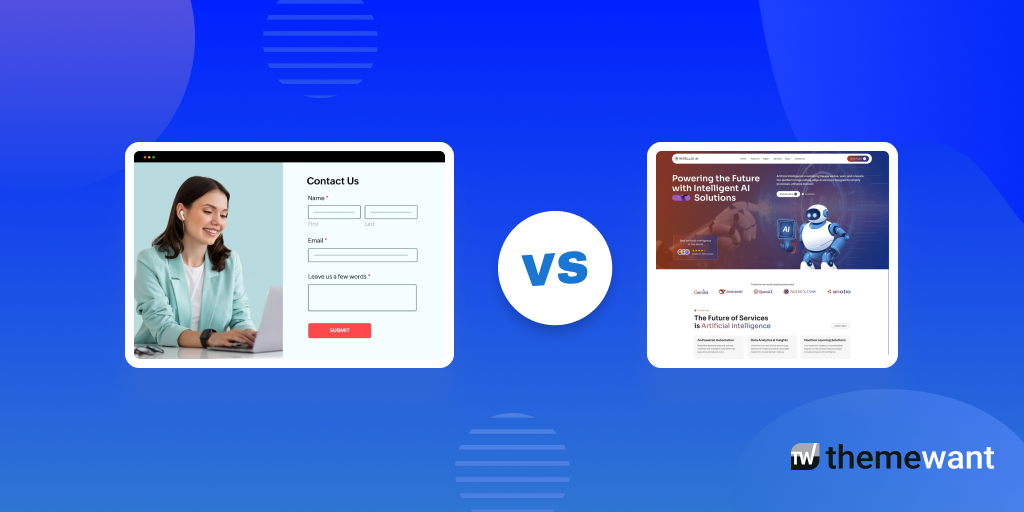
Every business wants more leads.
Yet many companies spend thousands on advertising, SEO, and social media only to send visitors to a page that doesn’t convert. The result is familiar: traffic goes up, but inquiries stay flat.
One of the biggest reasons is choosing the wrong conversion strategy. Should you place a contact form directly on your website? Or should you build a dedicated landing page?
The answer isn’t as straightforward as “landing pages are always better” or “contact forms are enough.” Each serves a different purpose, and understanding when to use each can dramatically improve your conversion rate.
Let’s explore the strengths, weaknesses, and best use cases of contact forms and landing pages.
Create High-Converting Contact Forms with BoldForm
What Is a Contact Form?
A contact form is a section of your website where visitors can submit inquiries, request quotes, ask questions, or start conversations.
You’ll usually find it on pages like:
- Contact Us
- Service Pages
- Pricing Pages
- About Us
- Footer sections
Its primary goal is simple:
Turn interested visitors into leads with minimal friction.
Most contact forms ask for basic information such as:
- Name
- Phone Number
- Company
- Message
Some businesses also include dropdowns, file uploads, appointment scheduling, or project details.
What Is a Landing Page?
A landing page is a standalone page built around one specific conversion goal.
Unlike a normal website page, it removes distractions like navigation menus, multiple CTAs, and unnecessary content.
Everything on the page pushes visitors toward one action.
That action could be:
- Book a demo
- Download an ebook
- Start a free trial
- Register for a webinar
- Request a quote
- Purchase a product
Landing pages are commonly used with:
- Google Ads
- Facebook Ads
- Email marketing
- Product launches
- Promotional campaigns
The Biggest Difference
Although both collect leads, they serve different purposes.
A contact form assumes the visitor has already decided to contact you.
A landing page persuades the visitor before asking them to convert.
That’s why landing pages usually contain:
- A compelling headline
- Benefits
- Social proof
- Testimonials
- Product images
- FAQs
- Trust badges
- Strong call-to-action
A contact page often contains none of these.
Why Contact Forms Sometimes Underperform
Many businesses accidentally make their contact forms difficult to complete.
Common mistakes include:
Too Many Fields
Asking for fifteen pieces of information feels like work.
Every additional field increases the chance someone leaves.
No Reason to Contact
Many pages simply say:
“Fill out the form.”
Why should visitors?
What’s in it for them?
Without a compelling reason, most people won’t take action.
Poor Placement
Some websites hide their contact forms behind multiple clicks.
Others place them only on the Contact page.
Many visitors never even reach that page.
Lack of Trust
Visitors hesitate when they don’t know who they’re contacting.
Missing trust elements include:
- Customer reviews
- Certifications
- Awards
- Client logos
- Team photos
- Security assurances
Trust directly affects conversion rates.
Why Landing Pages Often Convert Better
Landing pages are built using conversion psychology.
Everything has one purpose:
Get visitors to take action.
Here are several reasons they often outperform regular pages.
Single Focus
A homepage may ask visitors to:
- Read the blog
- Learn about services
- Explore pricing
- Visit the About page
- Watch videos
- Contact sales
That’s too many choices.
Landing pages eliminate decision fatigue.
Clear Value Proposition
Visitors instantly understand:
- What you’re offering
- Why it matters
- Why they should care
No guessing required.
Better Storytelling
Landing pages explain:
- The problem
- The consequences
- The solution
- The benefits
- The results
This naturally builds motivation before presenting the form.
Stronger Social Proof
Landing pages usually include:
- Testimonials
- Reviews
- Case studies
- Customer numbers
- Success stories
- Ratings
These reduce uncertainty.
Better CTA Placement
Landing pages repeat the call-to-action multiple times.
Visitors don’t need to scroll back to the top.
Do Landing Pages Always Convert Better?
Not necessarily.
It depends on visitor intent.
If someone searches:
“ABC Company phone number”
They probably just want your contact information.
Sending them through a long landing page creates unnecessary friction.
However, if someone clicks a Facebook ad promising:
“Get a Free Marketing Audit”
A dedicated landing page will almost always outperform sending them to a generic Contact page.
Intent matters more than page type.
When Contact Forms Work Best
Contact forms perform well when visitors already trust your business.
Examples include:
Existing Customers
Customers needing support don’t need persuasion.
They simply need a fast way to reach you.
Referral Traffic
If someone is referred by a satisfied client, they’re already warm leads.
A simple contact form is often enough.
Local Businesses
Restaurants
Law firms
Plumbers
Electricians
Real estate agencies
Medical clinics
Many visitors simply want to schedule an appointment.
A clean contact form works well.
Returning Visitors
Someone visiting your site for the fourth time doesn’t need another sales pitch.
They need an easy way to connect.
When Landing Pages Win
Landing pages shine when visitors are unfamiliar with your business.
They’re ideal for:
Paid Advertising
Every ad should match a dedicated landing page.
This keeps messaging consistent and increases conversions.
Lead Magnets
Offering:
- Free guides
- Templates
- Checklists
- Whitepapers
- Reports
A landing page explains the value before asking for information.
Product Launches
New products deserve focused attention.
Landing pages prevent distractions.
SaaS Demos
Software buyers often need:
- Features
- Screenshots
- Testimonials
- Integrations
- Pricing
A landing page answers these questions before requesting a demo.
Webinar Registration
People rarely register without understanding:
- What they’ll learn
- Who’s presenting
- Why it matters
Landing pages provide that context.
The Psychology Behind Higher Conversions
Landing pages use several proven psychological principles.
Clarity
Confused visitors don’t convert.
Simple messaging wins.
Authority
Awards, certifications, and customer success build confidence.
Social Proof
People trust businesses that others already trust.
Scarcity
Limited offers create urgency.
Examples include:
- Limited seats
- Early bird pricing
- Time-sensitive discounts
Reciprocity
Offering something valuable first encourages visitors to give their contact information.
Should Every Landing Page Include a Form?
Usually, yes.
But the form should match the value of the offer.
For example:
Downloading a checklist may only require an email address.
Requesting an enterprise software demo may justify asking for:
- Company size
- Job title
- Industry
- Budget
The higher the perceived value, the more information people are willing to provide.
How Long Should Your Form Be?
There isn’t a universal answer.
Short forms generate more leads.
Long forms generate better-qualified leads.
If your sales team spends hours filtering unqualified inquiries, adding a few qualifying questions can actually improve ROI.
It’s a balance between quantity and quality.
Common Mistakes Businesses Make
Many companies unintentionally reduce conversions by:
- Using generic headlines
- Asking for unnecessary information
- Including multiple CTAs
- Ignoring mobile optimization
- Not testing different versions
- Forgetting testimonials
- Making forms difficult to complete
- Using weak button text like “Submit”
- Not following up quickly
- Ignoring page loading speed
Even small improvements can significantly increase conversions over time.
Can You Combine Both?
Absolutely.
In fact, many high-performing websites do.
For example:
A visitor discovers your business through a Google ad.
They arrive on a landing page that explains your offer, showcases testimonials, answers common objections, and builds trust.
At the end of the page, they complete a contact form to request a demo or quote.
In this case, the landing page creates demand, while the contact form captures it.
This combination often delivers the best results.
Which Converts Better?
The real answer is:
It depends on where your visitors are in their buying journey.
If visitors already know, trust, and intend to contact you, a well-designed contact form can convert extremely well.
If visitors are unfamiliar with your business or need convincing before taking action, a dedicated landing page almost always has the advantage because it educates, builds trust, and guides them toward a single goal.
Rather than treating contact forms and landing pages as competing options, think of them as complementary tools. A landing page attracts and persuades, while the contact form captures the opportunity. When used together with clear messaging, compelling offers, and a streamlined user experience, they can significantly increase lead generation and improve the return on your marketing efforts.
Frequently Asked Questions: Contact Forms vs Landing Pages
Do landing pages have higher conversion rates than contact pages?
In many marketing campaigns, yes. Landing pages are designed around a single goal and typically include persuasive copy, social proof, and focused calls to action, which often leads to higher conversion rates than a standard contact page.
Should every website have a contact form?
Yes. A contact form gives visitors a simple and secure way to reach your business without exposing your email address publicly. It also helps organize inquiries and reduce spam.
How many fields should a contact form have?
Keep the form as short as possible while collecting the information you genuinely need. For general inquiries, asking for a name, email address, and message is usually sufficient. More complex services may require additional qualifying fields.
Can I use a contact form on a landing page?
Absolutely. This is one of the most effective approaches. The landing page builds trust and explains the offer, while the contact form captures the lead at the moment the visitor is ready to act.
What’s more important than choosing between a contact form and a landing page?
Understanding visitor intent. A perfectly designed landing page won’t perform well if it doesn’t match what visitors expect, and even the simplest contact form can convert effectively when someone is already ready to get in touch. Matching the page to the user’s stage in the buying journey is often the biggest factor in improving conversions.

